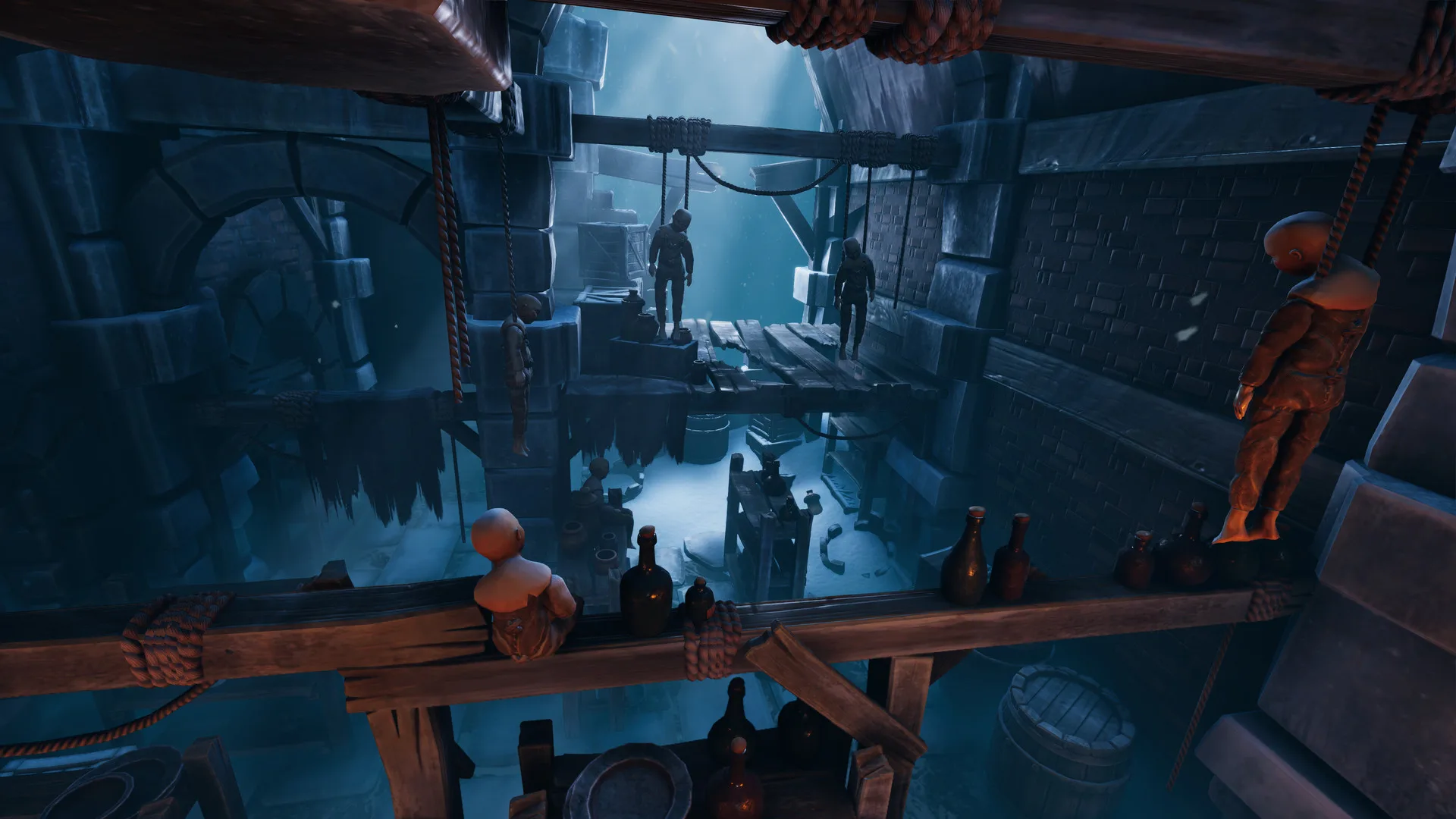
- We Were Here Forever chapters are location-based, not numbered stages.
- The adventure runs from Castle Rock prison through Rockbury, the Graveyard, and frozen depths.
- Each chapter focuses on asymmetric clues and walkie-talkie communication.
- Late-game chapters demand longer sequences and tighter coordination.
- The final escape combines navigation, timing, and story decisions.
How We Were Here Forever Chapters Work
We Were Here Forever does not use traditional numbered chapters. Instead, the adventure flows through a connected series of locations, beginning with two explorers imprisoned and separated inside Castle Rock and gradually expanding into abandoned settlements, frozen landscapes, and underground spaces. Understanding this structure helps you find where you are stuck and what kind of cooperative challenge comes next.
Video Highlights:
- Progression moves through Castle Rock, Rockbury, the Graveyard, and beyond
- Each area introduces new communication-based puzzle mechanics
- Later regions feature longer multi-stage cooperative chains
The core rule stays constant across every chapter: one player receives information the other cannot see, and progress depends on describing it accurately over voice. Visit the official Steam page for platform and language details.
| Chapter | Progression | Main Environment |
|---|---|---|
| Castle Rock | Opening | Prison cells and castle interiors |
| Castle Escape | Early Game | Castle chambers and mechanisms |
| Rockbury | Mid Game | Abandoned settlement and surroundings |
| Graveyard | Mid to Late Game | Markers, tombs, and structures |
| Frozen Depths | Late Game | Underground and undersea areas |
| Final Escape | Finale | Combined escape sequence |
Before searching for solutions, identify your current location and the last puzzle you solved. Because chapters are location-based, matching your surroundings to the table above is the fastest way to locate the right walkthrough section.
Early Chapters: Castle Rock and the Escape
The opening chapters establish the game's central mechanic. Both players begin separated, each locked in a different part of Castle Rock with only partial clues. Early puzzles are intentionally simple so teams can build the communication habits needed later.
Castle Rock (Opening)
- Separated rooms with walkie-talkie contact
- Symbol matching and basic mechanisms
- Teaches describing what only you can see
Castle Escape (Early Game)
- Shared mechanisms across chambers
- Navigation and pattern matching
- Introduces timing-based cooperation
Expect actions on one side of the castle to affect your partner's environment. Confirm every mechanism state before and after activating it, and change only one control at a time so neither player loses track of the puzzle.
Teams that guess through the castle sections often struggle later. The early chapters are where you should agree on symbol names, directional language, and confirmation habits. Invest in that vocabulary now.
Mid-Game Chapters: Rockbury and the Graveyard
After leaving the castle, the expedition opens into Rockbury, an abandoned settlement tied to the kingdom's history. Larger spaces make navigation and accurate descriptions far more important, because players may solve related tasks from entirely different locations.
The Graveyard follows, adding another layer of environmental puzzle solving centered on markers, structures, and spatial reasoning. Solutions frequently depend on matching information one player observes with objects only the other can reach.
| Chapter | Puzzle Focus | Communication Priority |
|---|---|---|
| Rockbury | Exploration, environmental clues, multi-stage puzzles | Landmark naming, consistent directions |
| Graveyard | Observation, matching clues, spatial reasoning | Position-first descriptions, marker identification |
Survey Before Solving
When entering a new Rockbury building or Graveyard area, both players describe their full surroundings and every interactive object before touching anything.
Name Permanent Features
Assign fixed names to landmarks, symbols, and structures, then reuse those names for the rest of the chapter.
Match Clues Across Areas
Compare the observing player's clues against the objects the acting player can manipulate, one item at a time.
Confirm Each Stage
Multi-stage puzzles change the environment. Confirm what changed after every step before continuing.
When several similar markers or objects exist, state where the object is located before what it looks like. Phrases like "top-left," "second from the right," or "nearest the gate" prevent most mid-game confusion.
Late Chapters: Frozen Depths and the Final Escape
Late progression leads beneath the icy surface into larger, more elaborate environments. Puzzle chains grow longer, mechanical systems become interconnected, and both players must hold a shared mental model of routes and machine states. The concluding stretch combines navigation, puzzle solving, and coordinated actions where both explorers perform different parts of the same escape sequence.
| Late-Game Challenge | Why It Is Harder | Recommended Habit |
|---|---|---|
| Mechanical systems | Interconnected controls across areas | Track machine states verbally |
| Route planning | Complex paths under the ice | Confirm positions each step |
| Sequential actions | Long chains with no shortcuts | Read full sequences aloud first |
| Final coordination | Timed paired actions | Countdowns and short confirmations |
The late chapters also carry the heaviest story revelations about the King, the ruined kingdom, and the Jester's role. If you want to go in unspoiled, finish the Final Escape before reading ending breakdowns.
Chapter Completion Checklist
Use this checklist to make sure each chapter is fully cleared before moving on, especially if you are chasing the game's 39 achievements, several of which tie into optional interactions hidden inside each region.
Before Leaving Each Chapter:
- Both players confirmed all puzzles in the area are solved
- Optional objects and side rooms explored and interacted with
- Symbol names and route notes kept consistent for later areas
- Any unusual or hidden interactions checked for secret achievements
- Progress and story details discussed with your partner
A second cooperative run is the practical way to clean up puzzle-specific or optional achievements missed on a first playthrough, since several depend on actions not required for basic progression.
Chapter FAQ
Q: Does We Were Here Forever have numbered chapters?
No. The game is organized by locations in story order, such as Castle Rock, Rockbury, the Graveyard, and the frozen depths, rather than numbered chapters or a chapter select menu.
Q: How long is each chapter in We Were Here Forever?
Early castle sections are shorter and tutorial-like, while mid-game areas like Rockbury and the late frozen depths contain larger multi-stage puzzles that take considerably longer to solve as a pair.
Q: Can I replay a specific chapter?
There is no traditional chapter select. To revisit an area for missed achievements or secrets, the standard approach is starting another cooperative run and progressing back to that location.
Q: Which chapter is the hardest?
Most teams find the late-game frozen depths the most demanding, because puzzle chains are longer, mechanisms are interconnected, and both players must maintain an accurate shared understanding of the environment.