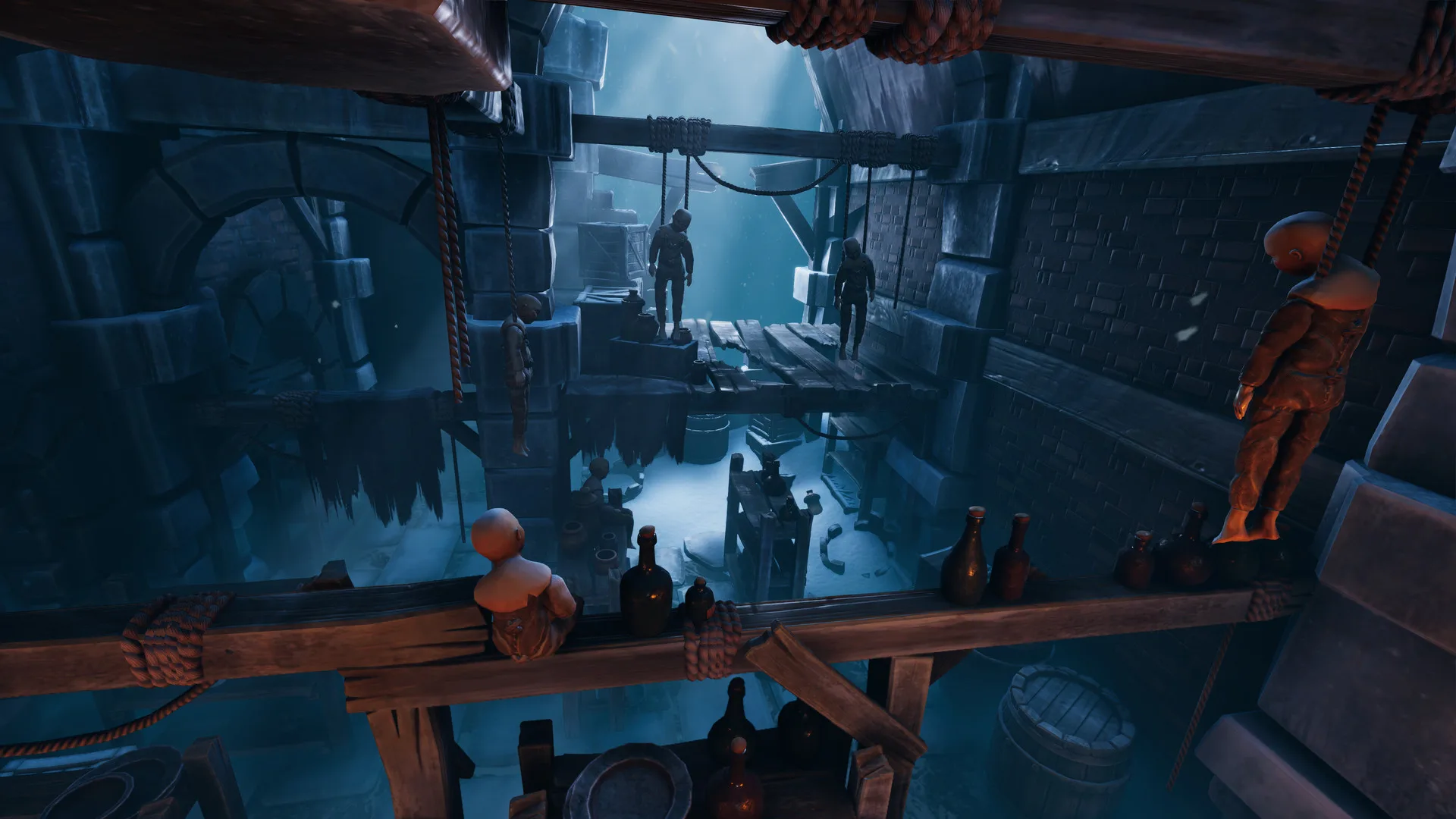
- We Were Here Forever hints work best when you fix your communication habits first, not the puzzles themselves.
- The game splits clues between two players, so describing what you see accurately matters more than solving fast.
- Every major puzzle falls into one of six repeatable patterns you can learn in advance.
- One-change-at-a-time testing prevents you from losing track of puzzle states.
- Timed sequences require agreed countdowns before either player acts.
Why Hints Beat Full Solutions in We Were Here Forever
We Were Here Forever is a two-player co-op puzzle adventure built entirely around asymmetric information. You and your partner are separated inside and around Castle Rock, and each of you only sees half of any given puzzle. The walkie-talkie is not a flavor element — it is the core mechanic. Because of this design, generic hints about communication and pattern recognition will carry you through almost the entire game, while a raw solution to one puzzle helps you exactly once.
The adventure progresses through Castle Rock's prison chambers, the abandoned settlement of Rockbury, the Graveyard, and later frozen underground regions. Puzzle complexity increases steadily, but the underlying cooperation logic stays consistent from the first room to the final escape sequence.
| Region | Progression Stage | Main Challenge |
|---|---|---|
| Castle Rock Prison | Opening | Separated rooms, basic symbol exchange |
| Castle Escape | Early game | Shared mechanisms, pattern matching |
| Rockbury | Mid game | Large spaces, multi-stage navigation puzzles |
| Graveyard | Mid-late game | Environmental observation, marker matching |
| Frozen Depths | Late game | Long mechanical chains, route planning |
| Final Escape | Finale | Precise timing and coordinated actions |
Before reaching for a full walkthrough solution, try applying the general hint categories in this guide to your current puzzle. Most stuck teams fail because of a communication breakdown, not because the puzzle is beyond them. Fix the communication and the solution frequently reveals itself.
The Six Puzzle Patterns and How to Handle Them
Every cooperative challenge in the game fits into a recognizable pattern. Once you can identify which pattern you are facing, the correct approach follows naturally.
Symbol Matching
- One player sees symbols; the other selects them
- Assign fixed names: crown, eye, hook, triangle
- Never change a name mid-puzzle
Navigation Puzzles
- One player holds the route; the other walks it
- Use fixed terms: forward, left, clock positions
- Confirm position after every single move
Paired Mechanisms
- One player controls; the other observes results
- Change only one mechanism at a time
- Describe exactly what changed before continuing
Sequence Puzzles
- One player reads the order; the other activates
- Read the full sequence aloud before touching anything
- Count each activation together out loud
Observation Puzzles
- Landmarks and decorations hide the clues
- State position first, appearance second
- Describe surroundings, not just the target object
Timed Actions
- Both players must act in a limited window
- Agree on a countdown before starting
- Use short confirmations: ready, go, stop, reset
| Pattern | Communication Key | Most Common Mistake |
|---|---|---|
| Symbol Matching | Consistent symbol names | Renaming symbols halfway through |
| Navigation | One instruction at a time | Stacking multiple directions rapidly |
| Paired Mechanisms | Report every change | Both players adjusting controls at once |
| Sequence | Read, repeat, then activate | Activating from memory without confirmation |
| Observation | Position before appearance | Vague references like "the thing on the left" |
| Timed Actions | Countdown agreement | Acting without confirming readiness |
If you find yourself or your partner guessing at inputs, stop. Guessing in We Were Here Forever almost always resets progress or wastes a timed window. Return to the beginning of the puzzle, restate every visible clue, and only act once both players agree on what should happen.
Communication Fundamentals That Solve Half the Game
The single most valuable We Were Here Forever hint is this: treat communication as a skill you practice, not something you assume works. Teams that establish good habits early finish puzzles dramatically faster than teams that improvise.
Describe Before Solving
Before attempting anything, both players should describe their surroundings, visible symbols, controls, and anything interactive. Half of all stuck moments come from one player failing to mention a detail the other player needed.
Speak in Short Pieces
Deliver one piece of information at a time and let your partner confirm it. Long, rambling explanations get lost, especially when one of you is navigating hazards or under time pressure.
Build a Shared Vocabulary
Create simple, memorable names for unfamiliar symbols and keep using them. Consistency turns a confusing glyph puzzle into a quick matching exercise.
Use Precise Position Language
Say "top-left," "second from the right," or "nearest the door" instead of pointing verbally at "that one." Position first, then appearance.
Retrace When Stuck
If progress halts, walk back to the start of the current puzzle and compare every clue again. Usually one player overlooked an object, symbol, or environmental detail.
Teams that adopt the one-change-at-a-time rule and the read-repeat-activate sequence rule in the opening castle sections consistently report smoother runs through Rockbury and the Graveyard, where puzzles chain multiple systems together.
Region-Specific Hints
Each major region introduces its own flavor of challenge. Use these hints to prepare before entering a new area rather than after getting stuck.
| Region | What to Prepare For | Practical Hint |
|---|---|---|
| Castle Rock | Separated rooms with simple symbol locks | Establish your naming vocabulary here while stakes are low |
| Castle Escape | Mechanisms that affect the other player's environment | Announce every lever or button before pulling it |
| Rockbury | Larger spaces, exploration-heavy puzzles | Describe permanent landmarks first for orientation |
| Graveyard | Markers and structures hiding matching clues | Inspect positions and orientations of every marker carefully |
| Frozen Depths | Long mechanical chains requiring state tracking | Keep verbal notes of what each control changed |
| Final Escape | Navigation, timing, and coordinated actions combined | Slow down — rushing the finale causes most failed attempts |
The transition into Rockbury is where many teams first struggle. Spaces open up dramatically, and you may be solving related tasks from completely different locations within the settlement. If descriptions suddenly feel confusing, pause and re-establish shared reference points — a tall tower, a distinct building, a path marker — before continuing.
By the Frozen Depths, puzzles routinely require both players to understand the full system, not just their own half. Make a habit of summarizing the whole mechanism back to each other before executing the final steps. This mutual understanding is what the final escape sequence tests.
Pre-Session Checklist and Common Pitfalls
Because We Were Here Forever is strictly a two-player online experience with no single-player fallback, session preparation matters. Voice communication is a core mechanic, and connection quality directly affects your puzzle-solving ability.
Before Starting a Session:
- Test microphones and confirm both players can hear clearly
- Confirm both players are on supported PC, PlayStation, or Xbox platforms with crossplay enabled
- Verify stable broadband connections on both ends
- Agree on communication rules: short phrases, confirmations, countdowns
- Set aside enough time — later puzzle chains do not pause conveniently
| Pitfall | Why It Fails You | Quick Fix |
|---|---|---|
| Talking over each other | Instructions get lost mid-sentence | Alternate: one describes, one confirms |
| Both players experimenting | Puzzle state becomes untrackable | Only one player touches controls at a time |
| Skipping descriptions | Hidden clues go unnoticed | Describe everything interactive at each new room |
| Rushing timed sequences | Limited windows get wasted | Rehearse the order, then execute with a countdown |
| Ignoring environmental art | Decorations often contain the clue | Inspect murals, markings, and layouts carefully |
| Panic after a reset | Teams abandon working logic | Retrace the puzzle from step one calmly |
If voice communication cuts out mid-puzzle, stop and fix the audio before continuing. Playing through broken voice chat in a game where describing symbols is the core mechanic leads to frustration, not progress. Check in-game voice settings, platform permissions, and your input device before restarting the session.
Frequently Asked Questions
Q: Can I get We Were Here Forever hints without spoiling the solutions?
Yes. Focus on identifying which of the six puzzle patterns you are facing, then apply the matching communication strategy. Pattern-based hints tell you how to think about the puzzle without revealing the specific answer, which keeps the experience intact while getting you unstuck.
Q: Why does my partner and I keep failing puzzles we understand?
In most cases the logic is correct but the execution communication is failing. Common causes include stacking multiple instructions at once, changing symbol names mid-puzzle, or both players adjusting controls simultaneously. Slow down, confirm each step, and change only one thing at a time.
Q: Do hints change between regions like Castle Rock, Rockbury, and the Graveyard?
The core communication hints stay the same everywhere, but each region emphasizes different patterns. Castle Rock focuses on symbol exchange, Rockbury adds large-space navigation, the Graveyard rewards careful observation of markers, and the late-game regions test mechanical state tracking and timing.
Q: Is there a way to practice communication before the harder puzzles?
Yes. Use the opening Castle Rock prison sections deliberately as practice. The stakes are low and the puzzles are simple, which makes them the ideal place to establish your naming vocabulary, confirmation habits, and countdown routines before Rockbury raises the difficulty.