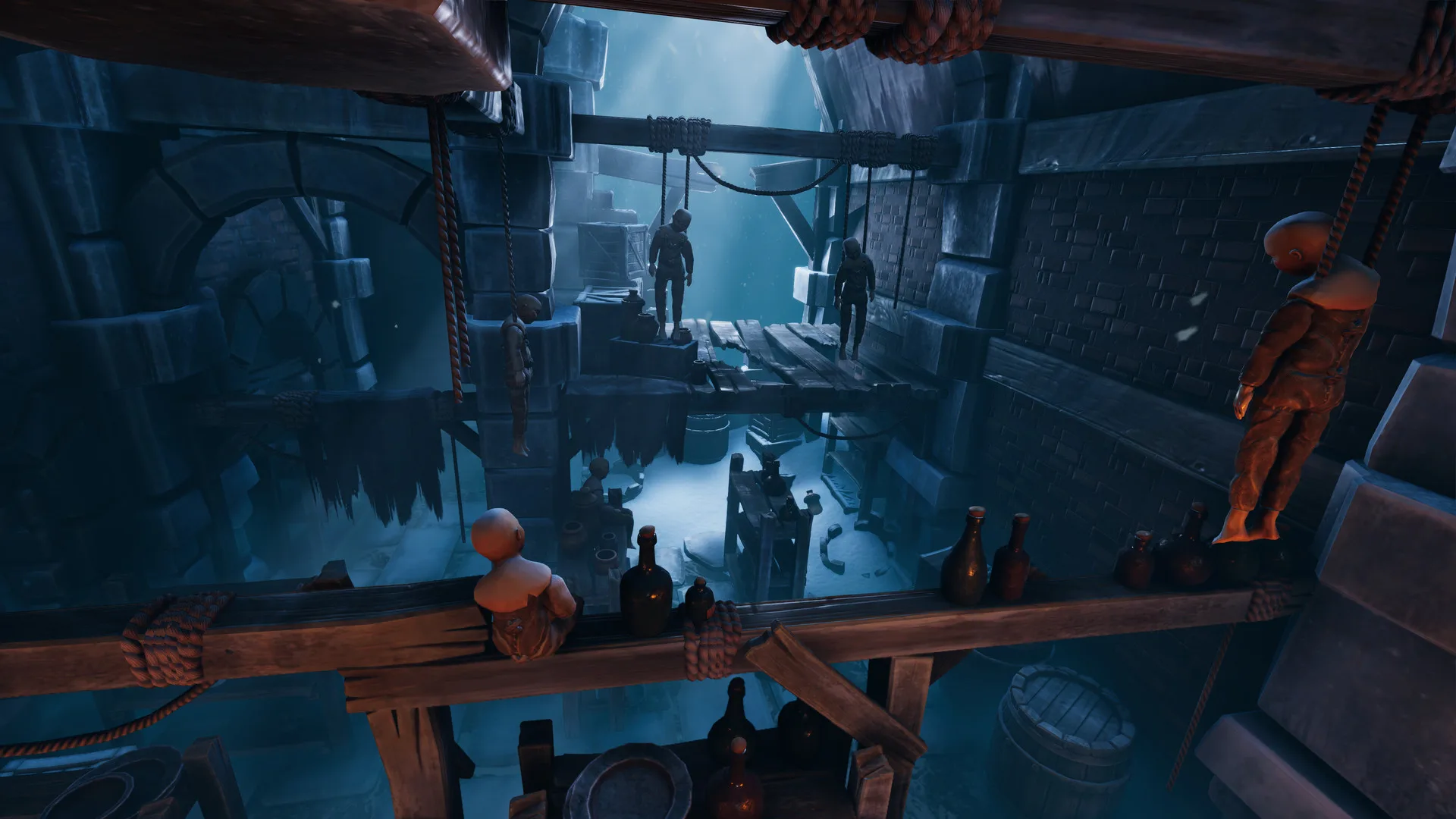
- We Were Here Forever jester puzzle: A co-op challenge tied to the Jester, the trickster force behind Castle Rock
- Core mechanic: Each explorer sees different clues, so every solution depends on clear walkie-talkie communication
- Best strategy: Agree on fixed names for symbols before touching any mechanism
- Common mistake: Activating multiple controls at once, losing track of the puzzle state
- Golden rule: Change one thing at a time and confirm results with your partner
Jester Puzzle Overview: What You Are Facing
The We Were Here Forever jester puzzle refers to the Jester-themed challenges woven through Castle Rock's co-op campaign. The Jester is the recurring antagonist of the series, the mocking puppet-master who separates the two explorers, splits every clue between them, and watches as they struggle to reunite. His puzzles follow the classic series pattern: one player holds the information, the other holds the controls, and neither can succeed alone.
Unlike straightforward door puzzles, Jester challenges often mix symbol matching, ordering, and observation into multi-stage sequences. That means communication failures cause more resets than the puzzles themselves. Before attempting any Jester section, both players should understand what role they are playing.
The Describer
- Sees the clue side: symbols, sequences, markings
- Must translate visuals into precise language
- Should use fixed, memorable names
The Operator
- Holds the control side: bells, levers, dials, switches
- Follows instructions one step at a time
- Reports exactly what changes after each action
The Jester's Trick
- Clues are always asymmetric between players
- Wrong inputs often reset or relock the sequence
- Patience beats speed in every stage
Do not guess. Randomly ringing, flipping, or pressing Jester mechanisms usually resets progress and forces both players to re-verify every clue from the beginning. Establish your naming system first.
Jester Puzzle Communication Fundamentals
Every Jester puzzle is solved twice: once verbally and once physically. The verbal solve is where most teams fail. Use these fundamentals to avoid the most common communication breakdowns.
Give each symbol or mechanism a short, stable name — bell, crown, eye, hook, moon — and never change it mid-puzzle. Switching from "the swirly one" to "the spiral" mid-sequence confuses your partner instantly.
| Principle | What to Do | Why It Matters |
|---|---|---|
| Position first | Say "top-left bell" before describing it | Prevents misidentification among similar items |
| One instruction at a time | Deliver, confirm, then continue | Stops lost steps in long sequences |
| Repeat back | Operator echoes each instruction | Catches misheard numbers and symbols |
| Change one control | Activate a single mechanism, then report | Keeps cause and effect traceable |
| Use clock positions | "3 o'clock symbol" instead of "the right one" | Removes left/right ambiguity |
Partners who establish a shared vocabulary before the first Jester mechanism consistently clear these sections faster than teams that improvise descriptions on the fly.
Step-by-Step Jester Puzzle Approach
While each Jester challenge has unique details, they all follow the same solution rhythm. Work through these five stages every time, and you will clear Jester sections without spoiler-heavy trial and error.
Survey Both Sides
Before touching anything, each explorer describes their full environment: visible symbols, controls, mechanisms, and anything interactive. Skipping this step is the single most common cause of getting stuck.
Build a Shared Map
Agree on names and positions for every symbol and control. Number them if needed — "bell one through five, left to right" — so both players reference the same mental layout.
Identify the Clue Type
Determine whether the Jester is asking for a match (find identical symbols), a sequence (activate in order), or a combination (set dials to match markings). The clue type dictates your method.
Execute One Action at a Time
The operator performs a single input, describes the result, and waits for the next instruction. If something relocks or resets, stop and re-verify the shared map rather than guessing corrections.
Confirm the Result
When the mechanism unlocks, both players should confirm the environment changed before moving on. Some Jester sections chain immediately into the next stage, and losing track of state carries errors forward.
Retrace the entire puzzle from the beginning. In nearly every case, a stalled Jester puzzle means one player overlooked a symbol, marking, or interactive object — not that the solution is unknown.
Common Jester Puzzle Types and Solutions
Jester challenges cluster into recognizable categories. Use this reference to quickly classify whatever variation you encounter and apply the matching solution method.
| Puzzle Type | Describer Sees | Operator Holds | Solution Method |
|---|---|---|---|
| Symbol matching | Symbol set or markings | Selectable objects or bells | Name symbols, compare one at a time, mark confirmed matches |
| Sequence ordering | Order clue or repeated pattern | Objects to activate in order | Read full sequence aloud, repeat back, count together while inputting |
| Paired mechanisms | Controls affecting partner's side | The resulting change or required state | Change one control, report effect, iterate until target state |
| Observation | Landmarks or decorative clues | Related objects to select | Describe permanent features and position, not vague directions |
| Timed cooperation | One half of a timed mechanism | The other half or moving obstacle | Agree on countdown, use short confirmations: ready, go, stop |
Always read the entire sequence aloud before the first input. Starting a sequence you only half-heard guarantees a reset and wastes both players' time.
Jester Puzzle Readiness Checklist:
- Both players described their full environment
- Shared names assigned to every symbol and control
- Clue type identified (match, sequence, or paired)
- Sequence read aloud and repeated back before input
- One-action-at-a-time rule agreed upon
The Jester's Story Role and Spoiler Notes
This section discusses the Jester's role in the story of We Were Here Forever. Stop here if you want the narrative to unfold naturally.
The Jester remains one of the central forces behind the explorers' ordeal across the entire series. In We Were Here Forever, his presence connects the game to the larger Castle Rock mystery, reinforcing the recurring cycle of imprisonment, puzzles, manipulation, and attempted escape that defines the franchise. Every Jester puzzle you solve is, narratively, another round of his game.
The final escape sequence carries a severe cost rather than a simple shared victory, and the Jester's influence looms over that ending. The series' central theme holds: trust between two partners does not guarantee both escape safely, and Castle Rock always keeps a piece of those who enter.
| Story Element | Spoiler Level | Key Point |
|---|---|---|
| Two prisoners separated | Light | Escape requires split clues and cooperation |
| Rockbury's ruins | Moderate | Environmental storytelling reveals the fallen kingdom |
| The Jester's influence | Major | He drives the cycle of puzzles and manipulation |
| The final escape | Ending | Escaping carries a heavy cost, not a clean victory |
FAQ
Q: Can the We Were Here Forever jester puzzle be solved solo?
No. We Were Here Forever is designed exclusively for two-player online co-op. Jester puzzles split clues and controls between the two explorers, so a single player physically cannot see both halves of the solution.
Q: Why does our jester puzzle keep resetting?
Resets almost always come from wrong inputs made while guessing, or from activating multiple controls at once. Slow down, re-verify your shared symbol names, and execute one action at a time with the operator reporting every change.
Q: What is the best way to describe jester symbols to my partner?
Use position first, then a fixed memorable name. Say 'top-left, the crown symbol' and keep that exact name for the rest of the puzzle. Never change terminology mid-sequence.
Q: Do my friend and I need to be on the same platform for the jester puzzle?
No. We Were Here Forever supports cross-platform multiplayer across PC, PlayStation, and Xbox, so you can tackle the jester puzzle together as long as both players have an online connection and voice communication.