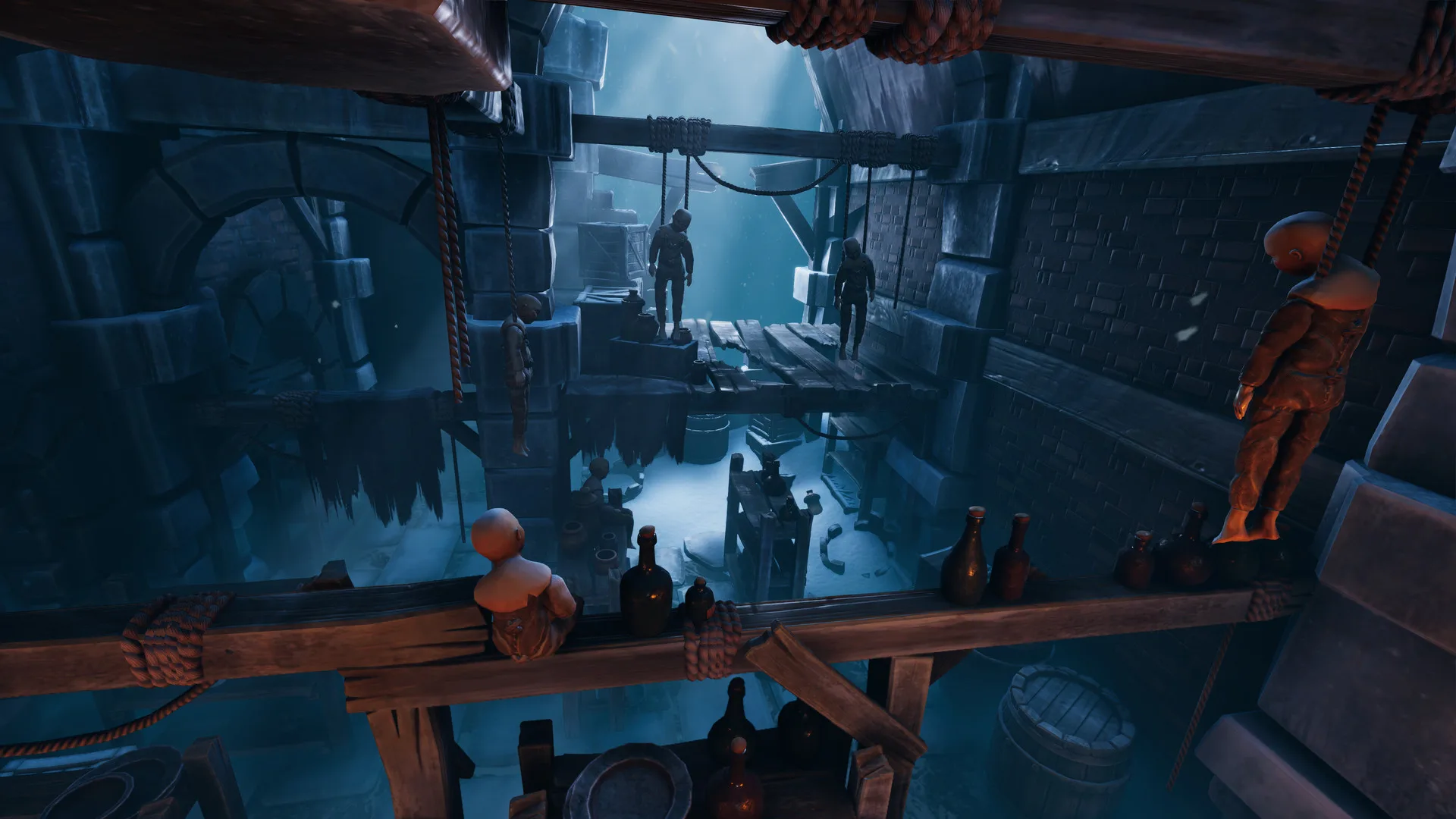
- We Were Here Forever mannequin puzzle takes place in Rockbury's tailor shop during the mid-game.
- One player reads outfit descriptions and clothing clues while the partner dresses the mannequins.
- Position language matters: agree on mannequin names and clothing-slot names before starting.
- Change one garment at a time and confirm each result with your partner.
- Related puzzles appear throughout Rockbury, so the communication habits you build here carry into later chapters.
How the Mannequin Puzzle Works
The We Were Here Forever mannequin puzzle is one of the standout cooperative challenges in the Rockbury section of the adventure. Like every puzzle in the game, it is built on asymmetric information: the two explorers are separated, each sees only part of the solution, and the walkie-talkie is the only bridge between them.
In this puzzle, one player finds themselves among mannequins that can be dressed or rearranged, while the other player discovers clues describing how the figures should look — references to garments, colors, positions, or arrangements found in the surrounding environment. Neither player can solve it alone. The clue reader cannot touch the mannequins, and the mannequin operator cannot see the clues.
This puzzle sits squarely within the Rockbury chapter, the mid-game stretch where spaces open up and description-based cooperation becomes far more demanding than in the tight Castle Rock chambers. If you arrived here stuck, the structure below will help you untangle it.
Establish a shared vocabulary first. Name each mannequin (for example, "left, middle, right" or "one through four") and agree on names for every garment type and slot. Fixing your vocabulary before touching anything prevents most failed attempts.
The table below summarizes the core information split:
| Puzzle Role | Player One (Clue Reader) | Player Two (Operator) |
|---|---|---|
| What they see | Written or visual clues describing target outfits | Mannequins plus available garments or controls |
| What they cannot see | The mannequins and clothing options | The clue descriptions |
| Main action | Describe clues accurately, one item at a time | Dress or arrange mannequins, report results |
| Common failure | Vague wording like "the fancy one" | Changing multiple garments before confirming |
Step-by-Step Solution Approach
Because We Were Here Forever deliberately splits information, the solution is less about a fixed answer and more about a reliable procedure. Follow these steps with your partner to work through the mannequin challenge systematically.
Survey Both Sides
Before attempting anything, each player describes their full environment. The clue reader summarizes every clue found; the operator counts the mannequins, lists all available garments, and notes any interactive slots or levers nearby.
Name Every Mannequin and Garment
Assign stable names to each mannequin by position, and label every garment type. Use consistent terms such as "hat, coat, scarf" — never switch to synonyms halfway through, or confusion is guaranteed.
Read One Clue Aloud, Fully
The clue reader reads a single clue completely, then the operator repeats it back for confirmation. Do not begin dressing until both players agree on what the clue describes.
Dress One Garment at a Time
The operator applies exactly one garment or change, then reports what changed. If anything in the environment reacts — a sound, a light, a door — describe it immediately, because environmental feedback often confirms a correct step.
Cross-Check Remaining Clues
After each attempt, re-read the remaining clues and eliminate satisfied conditions. If nothing works, retrace: an overlooked clue or a misidentified garment is almost always the cause rather than a wrong mechanic.
The most common failure pattern is rushing: both players changing or describing several things at once and losing track of the puzzle state. If a sequence of attempts fails, reset mentally — or physically, if the puzzle allows — and go back through the clues one by one.
Communication Framework for Clothing Clues
Rockbury's puzzles, including the mannequin challenge, punish imprecise language. The difference between ten minutes and an hour is usually description quality. Use this framework to keep descriptions tight and unambiguous.
Describe Position First
- Always start with where, not what
- Use "left," "middle," "second from the right"
- Clock-face positions work for circular layouts
- Never say "the one near the thing" without a landmark
Lock In Garment Names
- Pick one name per garment and never vary it
- Distinguish similar items explicitly, e.g. "long coat" vs "short coat"
- Confirm colors and orientation if the clue mentions them
- If a clue is ambiguous, both players discuss it before acting
Confirm Every Change
- Operator narrates each action: "done, nothing happened"
- Report environmental feedback instantly
- Clue reader tracks which clues are satisfied
- Re-verify the full setup if progress stalls
This description discipline applies directly to how the puzzle roles divide:
| Communication Habit | Why It Matters Here | Example |
|---|---|---|
| Fixed directional language | Mannequin order must match clue order | "Middle mannequin, add the hat" |
| One instruction at a time | Prevents lost puzzle state | "Coat on. Confirm." Then next |
| Read-back confirmation | Catches misheard garment names | Operator repeats the clue before acting |
| Change-then-report loop | Links causes to environmental effects | "Scarf added — I heard a mechanism click" |
Troubleshooting and Common Failure Points
If the mannequin puzzle still refuses to cooperate, work through the checklist of failure points below. Nearly every stalled attempt traces back to one of these issues.
Run Through These Checks:
- Every clue has been read aloud in full, with no skipped lines
- All mannequins and garments have agreed, stable names
- Each garment change was confirmed before the next one
- Environmental feedback (sounds, lights, opened routes) was reported
- Nearby rooms were explored for additional clues the reader may have missed
One underused trick in Rockbury generally: explore before retrying. Several mid-game puzzles hide secondary clues in adjacent rooms or on objects the clue reader walked past. A two-minute sweep of the surrounding area often reveals the missing description that unlocks everything.
Correct mannequin configurations typically produce clear feedback — a mechanism releasing, a route opening, or a sound confirming success. If you get partial feedback, part of your configuration is right; change only the garments you are least certain about and observe again.
| Symptom | Likely Cause | Fix |
|---|---|---|
| No feedback at all | Clues misread or incomplete | Re-read every clue; search nearby rooms |
| Partial feedback | Some garments correct | Keep confident items, adjust uncertain ones |
| Feedback but door stays shut | A second configuration step exists | Look for additional controls or a second clue set |
| Partner confusion mounts | Vocabulary drifting | Stop, rename everything, restart from clue one |
How the Mannequin Puzzle Fits Rockbury
The mannequin challenge is a good representation of what the Rockbury chapter expects from a partnership. After the confined opening chambers of Castle Rock, Rockbury's abandoned settlement spreads puzzles across larger spaces, meaning the two explorers frequently solve related tasks from entirely different locations within the same system.
| Rockbury Challenge Type | Skill Tested | Mannequin Puzzle Connection |
|---|---|---|
| Clue-to-object matching | Accurate description | Direct — outfits described from afar |
| Environmental observation | Landmark recall | Mannequin positions anchored to room layout |
| Multi-stage mechanisms | State tracking | Change-one-thing reporting loop |
| Sequence coordination | Ordered execution | Clues often describe an ordered arrangement |
Mastering the describe-confirm-change loop on the mannequins prepares you for the Graveyard and the frozen depths that follow, where the same communication pattern scales up to longer puzzle chains. Treat this puzzle as practice for precision, not just an obstacle between you and the next area.
We Were Here Forever is the fourth entry in Total Mayhem Games' two-player co-op puzzle series, built entirely around asymmetric clues and voice communication on PC, PlayStation, and Xbox with cross-platform support. The mannequin puzzle is a signature example of that design philosophy in action.
FAQ
Q: Where does the mannequin puzzle appear in We Were Here Forever?
The mannequin puzzle is part of the Rockbury chapter, the mid-game section that follows the Castle Rock escape. It is one of the larger description-based cooperative challenges in that area.
Q: Can both players see the mannequins in this puzzle?
No. Like all We Were Here Forever puzzles, information is split asymmetrically. One player interacts with the mannequins and garments while the other finds and reads the clues describing the required configuration.
Q: What is the fastest way to solve the mannequin puzzle?
Agree on names for every mannequin and garment before starting, then apply one garment at a time with the operator reporting each result. This change-confirm loop eliminates almost all wasted attempts.
Q: What should we do if no feedback appears after dressing the mannequins?
Re-read every clue aloud in full, verify no garment names were confused, and search adjacent rooms for missed clues. Missing or misidentified information is a far more common cause than a wrong mechanic.